
Internal Wiring Selection and Safety Compliance Verification for Energy Storage Cabinets
Why a “One-Size-Fits-All” Wiring Approach Fails in Energy Storage Cabinets
Internal routing inside an energy storage cabinet is dense and intricate. Some engineers, seeking to streamline procurement and assembly, attempt to standardize on a single wire type across the entire cabinet. This often leads to severe failures: PVC insulation softens and deforms in high-temperature zones, while 300 V–rated wires suffer dielectric breakdown or arcing in high-voltage circuits—resulting in immediate rejection during safety compliance audits.
Choosing between UL1015 and UL1332 requires a rigorous evaluation of three critical criteria: thermal operating zone, operating voltage, and conductor gauge (AWG).
Specification Overview & Positioning
- UL1015: A general-purpose PVC-insulated AWM wire, commonly rated at 105°C and 600 Vac / 750 Vdc. It accommodates conductor sizes from 30 AWG up to 2000 kcmil, with an average insulation thickness of 30 mils for smaller gauges.
- Positioning: Cost-effective, general-purpose wiring for ambient-temperature applications and power distribution.
- UL1332: A high-temperature fluoropolymer wire insulated with FEP (Fluorinated Ethylene Propylene / Teflon), rated at 200°C and 300 Vac. The conductor range caps at 10 AWG, with a nominal insulation thickness of only 13 mils, providing a thin-wall profile with outstanding dielectric properties.
- Positioning: Specialized high-temperature wire designed for compact, low-current circuits.
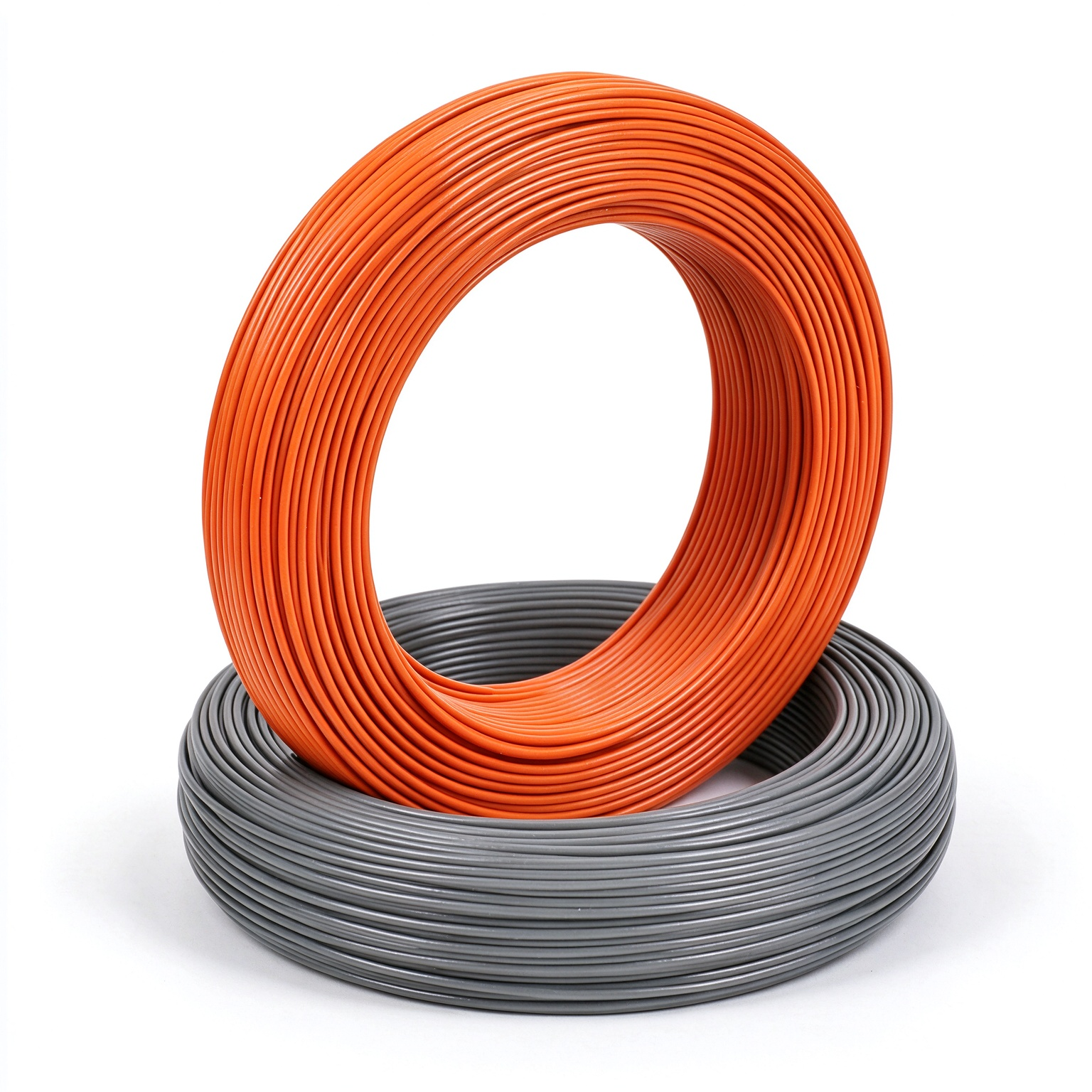
Head-to-Head Comparison: Five Key Parameters
- Temperature Rating:
Standard PVC tops out around 105°C, whereas FEP withstands continuous operation at 200°C. In localized hot spots near battery cells and power conversion system (PCS) inverters, this 95°C delta is mission-critical. - Voltage Rating (Inverse Relationship):
UL1015 supports up to 600 Vac / 750 Vdc. In contrast, UL1332 is rated for only 300 Vac and must never be deployed in high-voltage circuits. - Conductor Sizing Range:
UL1015 covers massive conductors up to 2000 kcmil to handle high-current busbar connections. UL1332 caps at 10 AWG, making it suitable strictly for low-current signal and control lines. - Insulation Thickness & Mechanical Durability:
Comparing 30 mils (UL1015) against 13 mils (UL1332): the thin-wall construction of UL1332 offers less mechanical resistance against abrasion, pinching, and sharp sheet-metal edges. - Cost & Sourcing:
PVC is highly economical, while FEP carries a significant cost premium. FEP should only be specified where high-temperature performance is strictly necessary.
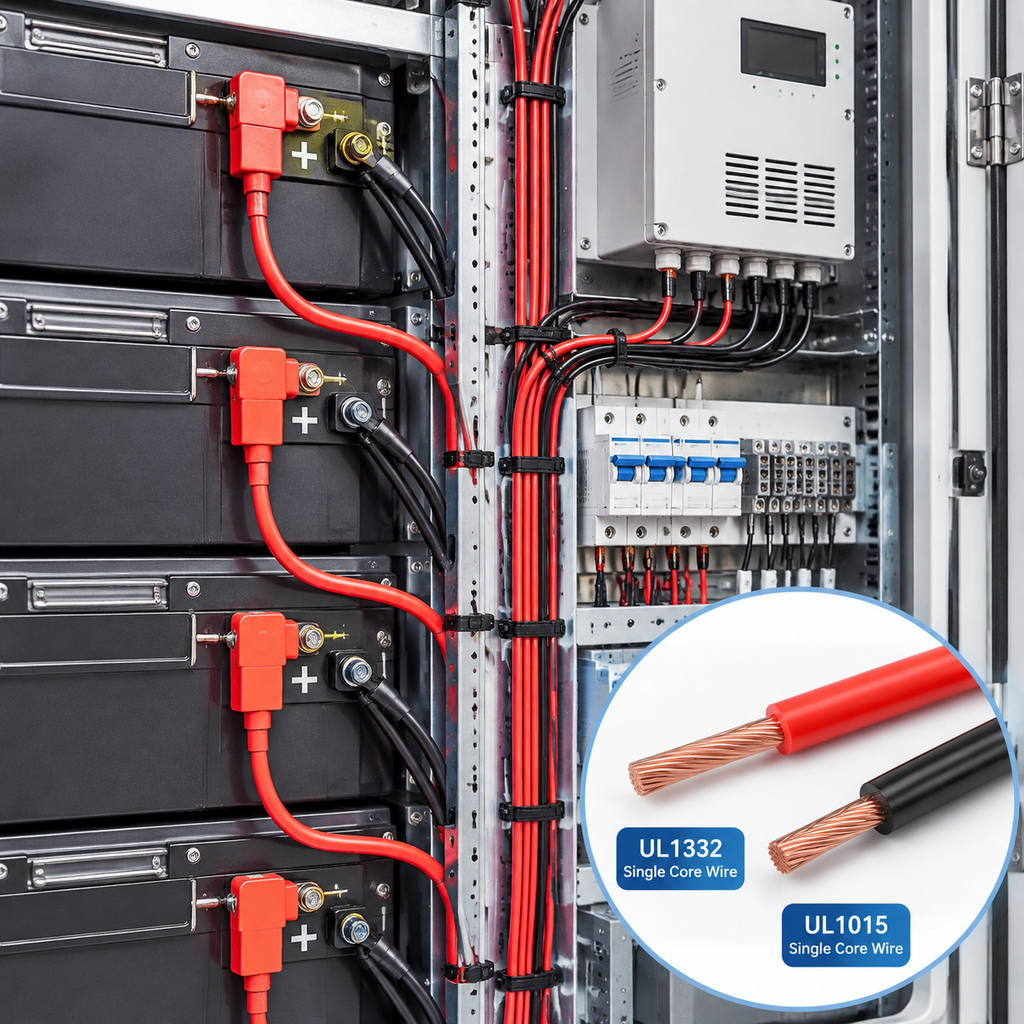
Internal Wiring Selection Strategy for Energy Storage Cabinets
- High-Voltage Main Circuits (typically 600 V to 1500 V DC):
UL1332’s 300 V rating is entirely insufficient. UL1015’s 750 Vdc rating is only viable up to 600 V–class systems. For systems operating at ≥1000 V DC, dedicated high-voltage lead wires (such as UL3239 rated for 3 kV+) must be selected—neither UL1015 nor UL1332 should be forced into this role. - High-Temperature Zones (>105°C near battery packs/cells and inverters):
Deploy UL1332 to leverage its 200°C thermal endurance. - Standard-Temperature Circuits (Signal, Control, Auxiliary Low-Voltage):
UL1015 PVC provides a dependable, cost-efficient, and fully compliant solution.
Six Key Checkpoints for Safety Compliance Verification
- UL Style Page & Product iQ Consistency:
Verify the manufacturer’s UL Style Page or UL Product iQ listing for temperature, voltage, conductor range, insulation material, and flammability rating. The surface marking must clearly indicate AWM, Style number, temperature rating, voltage rating, UL Recognized Component Mark, and manufacturer ID, matching design documentation item-for-item. - Voltage Margin Verification:
Operating system voltage (including transient overvoltage/surges) must stay comfortably below the wire’s rated voltage. UL1332 is strictly limited to 300 V and must not be used in circuits exceeding this threshold. - Thermal Zone Matching:
Map ambient and localized hotspot temperatures against wire ratings (PVC ~105°C vs. FEP 200°C) to prevent thermal degradation. - Conductor Cross-Section & Ampacity:
Observe the 10 AWG ceiling on UL1332. All high-current circuits must route via UL1015 or dedicated heavy-gauge power leads. - Flame Retardancy Ratings:
While both styles meet baseline horizontal flame test requirements, critical energy storage safety designs should confirm vertical flame retardancy (e.g., VW-1) where required by the end-product standard. - Application Boundaries (Internal vs. External Interconnect):
UL 758 AWM is a UL Recognized Component designated exclusively for factory-installed internal wiring within an enclosure. Any external interconnect cabling routed outside the cabinet must adhere to finished cord/cable standards (e.g., UL 62, UL 44).
Real-World Pitfalls and Lessons Learned
- Case 1: Over-Specifying Temperature at the Expense of Voltage
A manufacturer standardized cabinet-wide on UL1332 for its premium heat resistance. However, the DC main bus operated at 600 V, while UL1332 is rated only for 300 V. The design failed safety compliance inspection and required an expensive redesign and retrofit. - Case 2: Under-Specifying Temperature to Cut Costs
Another manufacturer used UL1015 PVC across the board. During high-rate fast-charging cycles, localized temperatures inside the battery compartment exceeded 120°C, causing the insulation to soften, swell, and blister. The issue was resolved only after retrofitting the high-heat zones with UL1332.
Why choose ADS Cable
Haiyan ADS Special Cable Co.,Ltd are a professional electric cable manufacturer for 30 years. UL1332 and UL1015 both are hot selling products,we provide with fast delivery and good quality products, welcome to have a quotation!